

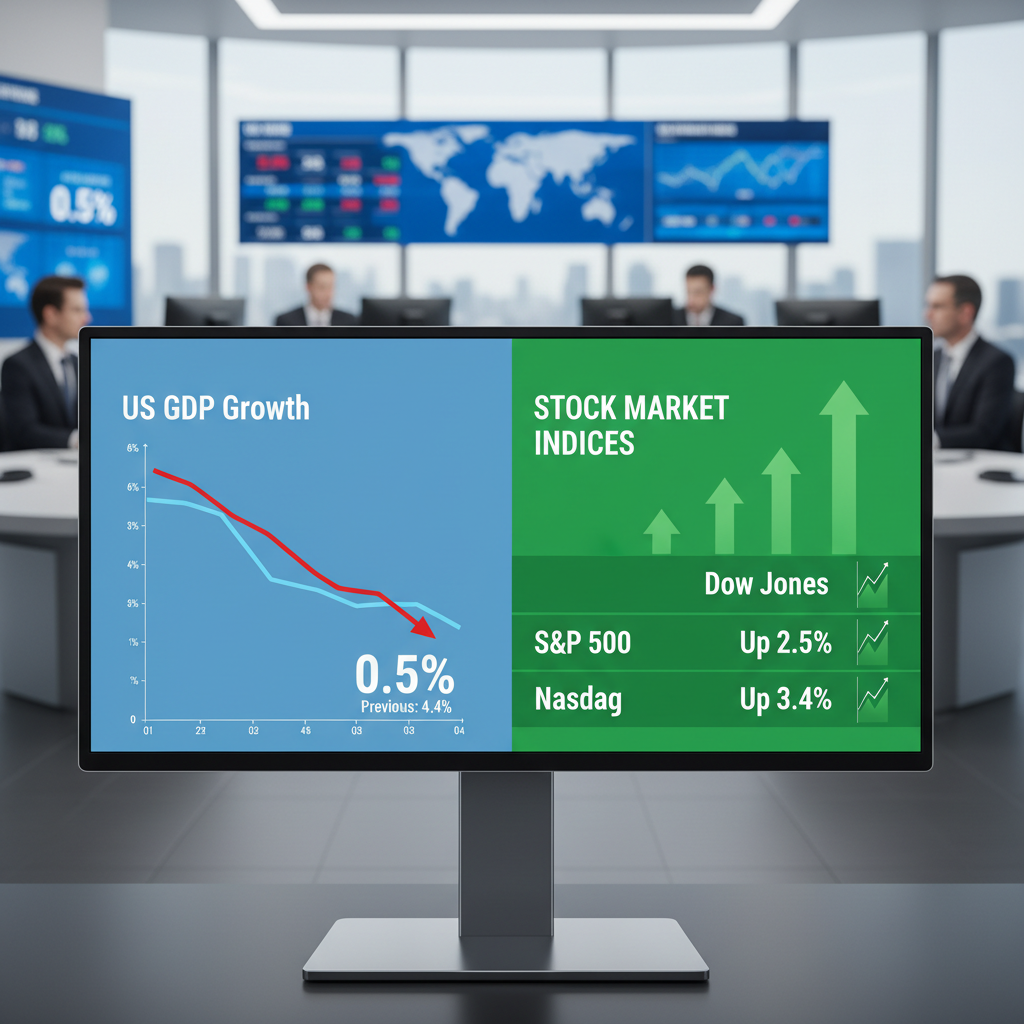
US GDP Growth Slows to 0.5% Amid Stock Market Surge and Investor Optimism
The latest data reveals a startling slowdown in US GDP growth, with the annualized rate dropping to 0.5% last quarter.
Despite this, the stock market surged, with the Dow Jones up 2.6%, driven by optimism and hints of rate cuts.
This contrast between slowing growth and rising markets highlights the economy’s complex state.
While cautious signs loom, investor confidence suggests better days might lie ahead.
This dynamic tension shapes both Wall Street’s future and the everyday realities of Main Street.
Read more:
perplexity.ai
Economic Crossroads: US GDP Growth Stalls as Markets Surge in Optimism
In a twist that captures the complexity of today’s economic landscape, the latest data reveals a startling slowdown in US GDP growth, with the annualized rate grinding to a mere 0.5% last quarter. This steep deceleration from the robust 4.4% expansion seen previously paints a sobering picture of cooling momentum. Beneath this surface lies the persistent tug-of-war between inflationary pressures and rising interest rates, factors that have tempered the economy’s previous vigor. The subdued growth signals cautious days ahead, with economists closely watching the Federal Reserve for the next moves in its policy playbook.
Yet, in a testament to the market’s resilience and forward-looking nature, the stock market danced in the opposite direction. The Dow Jones Industrial Average soared by an eye-popping 1,215 points—a 2.6% surge—heralding a wave of optimism among investors. The S&P 500 and Nasdaq didn't lag behind, climbing 2.5% and 3.4%, respectively, fueled by renewed faith in the tech sector and whispers of impending rate cuts. This rally suggests that despite the economic slowpoke in GDP growth, the stock market believes better days may soon be on the horizon.
What does this mean for the everyday observer? On one hand, the flag of caution is raised; slower GDP growth often signals challenges ahead for everything from job creation to wage increases. On the other, the stock market’s upward trajectory hints at underlying confidence that inflation could ease and borrowing costs might lighten, potentially paving the way for renewed investment and consumer spending. This dynamic duo of data—slowing growth clashing with soaring markets—reflects a pivotal moment in the US economy’s journey.
Travelers and global citizens, too, feel these tremors. As the world’s largest economy teeters between restraint and rebound, currency valuations, fuel prices, and even airfares can ripple accordingly. For now, the dance between caution and optimism injects a suspenseful energy into financial corridors that will shape both Wall Street’s highs and Main Street’s realities in the months ahead. As markets continue their rhythmic dance with economic signals, one thing is certain: the story of US growth and market resilience remains as riveting as ever.
Questions and answers
Q: Latest US GDP growth data
A: The latest US GDP growth data indicates a moderate expansion in the economy, reflecting steady consumer spending and business investment. However, growth rates may vary by quarter due to factors like supply chain disruptions and global economic conditions. Recent figures show a cautious optimism, with growth expected to continue but at a potentially slower pace compared to previous years.
Q: Impact of inflation on US economy
A: Inflation affects the US economy by increasing the cost of goods and services, which can reduce consumers' purchasing power and slow economic growth. Persistent high inflation often leads to higher interest rates as the Federal Reserve attempts to control price rises. While moderate inflation can signal a growing economy, excessive inflation creates uncertainty for businesses and consumers, potentially dampening investment and spending.
Q: Federal Reserve interest rate policy
A: The Federal Reserve uses interest rate policy to manage economic growth and control inflation. By raising rates, the Fed aims to cool down an overheating economy and curb inflation, while lowering rates is intended to stimulate borrowing and investment during slowdowns. Current policy decisions are closely watched as they influence borrowing costs, consumer spending, and overall economic stability.
Q: Stock market performance despite slow GDP
A: The stock market can perform well even when GDP growth is slow due to factors like strong corporate earnings, investor optimism, and accommodative monetary policies. Stocks often reflect future expectations rather than current economic conditions, so investors may price in anticipated economic improvements or sector-specific growth. Additionally, low interest rates can make equities more attractive compared to bonds, supporting market gains despite sluggish GDP growth.
Q: Relationship between GDP growth and stock market
A: There is a general relationship where positive GDP growth tends to support higher stock market returns because it signals a healthy economy and company profits. However, the stock market also reacts to other factors like interest rates, investor sentiment, and global events, which can cause stock prices to diverge from GDP trends. Over the long term, sustained GDP growth usually helps fuel stock market appreciation, but short-term movements may not always align.
Key Entities
United States: The United States has experienced a significant decline in stock markets, with major indices falling sharply. This economic development has raised concerns about the broader impact on both domestic and global financial stability.
Federal Reserve: The Federal Reserve influences monetary policy in the United States, affecting interest rates and economic activity. Recent stock market declines suggest investor uncertainty about potential Fed actions amid economic pressures.
Dow Jones Industrial Average: The Dow Jones Industrial Average fell by 450 points, marking its worst loss since December. This decline reflects investor reaction to economic indicators and policy expectations.
S&P 500: The S&P 500 index dropped 2.6%, with all its sectors ending lower for the week. This broad market decline indicates widespread investor caution across multiple industries.
Nasdaq: The Nasdaq Composite fell 3.3%, hitting its lowest level since February and entering correction territory. This drop underscores significant losses in technology and growth stocks.
External articles
- Why Does the Fed Care about Inflation?
- The Fed - Monetary Policy:
- The U.S. economy in 2026: What to watch for
Articles in same category
- Frontline (FRO) Valuation and Growth Amid Rising Oil Demand
- CRISPR Therapeutics Unveils Promising AATD Gene Editing Data
- Aston Martin Issues Profit Warning on Tariff Impact
YouTube Video
Title: WATCH: US Stocks Close Mixed After Shocking Inflation Data Sparks Market Volatility | DRM News |AF14
URL: https://www.youtube.com/shorts/gxJpNmIS9Us
Money