

Global Financial Shifts December 2025: Unemployment, Energy & Market Divergence
December 2025 reveals a financial landscape marked by contrasts and uncertainties.
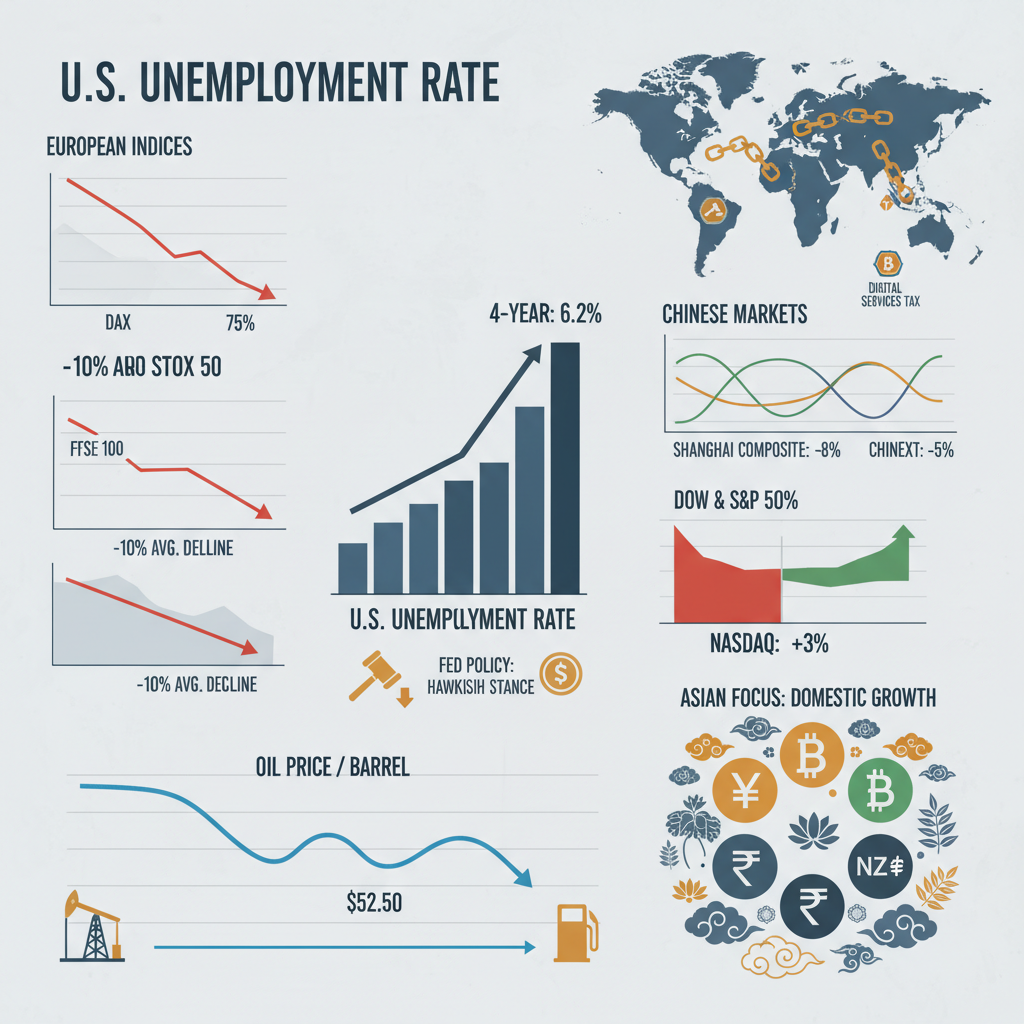
The U.S. unemployment rate hits a four-year high, complicating Federal Reserve policy prospects.
Stock markets show divergence: European and Chinese indices retreat, while the Nasdaq gains.
Oil prices plunge to near four-year lows amid supply glut fears and tentative Russia-Ukraine peace progress.
Geopolitical tensions rise with U.S.-EU disputes over digital taxes and expanding carbon border policies.
Asia focuses on boosting domestic demand and economic outlooks.
Navigating 2025 requires agility amid shifting global financial trends.
Read more:
perplexity.aiSummary
Global Financial Shifts in December 2025: Unemployment, Energy, and Market Divergence Paint a Complex Picture
As the year draws to a close, December 2025 reveals a financial landscape marked by surprising contrasts and mounting uncertainties. The U.S. economy, a central barometer of global health, has shown unexpected tremors with its unemployment rate hitting a four-year high. This development not only unsettles the labor market but also casts a shadow over the Federal Reserve’s future policy directions, complicating prospects for anticipated interest rate cuts. Investors and analysts alike are recalibrating their expectations amid this cooling labor environment, which has triggered ripples of volatility across currencies, government bonds, and stock markets.
The stock markets themselves reflect this theme of divergence. Across the Atlantic and Pacific, major European indices such as the DAX, FTSE 100, and Euro Stoxx 50, alongside China's key indices like the Shanghai Composite and ChiNext, have all retreated, signaling widespread risk aversion. In the U.S., however, the picture is mixed: while the Dow and S&P 500 have dipped, the tech-heavy Nasdaq managed to eke out gains, buoyed by giants like Tesla and NVIDIA. This rotation within growth and technology stocks underscores investor caution balanced by pockets of optimism related to innovation and future potential.
Meanwhile, the energy sector is grappling with its own concerns. Oil prices have plunged to nearly four-year lows, with West Texas Intermediate briefly dipping under $55 a barrel. This drop, driven by fears of a global supply glut and tentative progress toward a Russia-Ukraine peace agreement, sends unease throughout energy markets. Producers face mounting pressure, and energy-linked credit markets remain vulnerable, highlighting the fragile interplay between geopolitics and commodity economics.
On the regulatory and geopolitical front, tensions simmer as the U.S. threatens retaliatory measures against the European Union’s proposed digital services tax. This escalating dispute hints at renewed transatlantic trade friction, with potential repercussions for major technology platforms and international investment flows. Concurrently, the EU is preparing to broaden its carbon border taxes, signaling a firmer stance in climate-driven trade policy that could reshuffle global supply chains, especially in energy-intensive sectors.
Amid these global dynamics, Asia is setting its own course. China’s financial planners have prioritized expanding domestic demand for 2026, focused on structural upgrades in consumption and stronger market competition. In Southeast Asia, the Bank of Thailand’s impending interest rate decision will be closely watched for clues about the region’s economic outlook and capital flows. Meanwhile, the Indian rupee’s recent rebound against the U.S. dollar and New Zealand’s sizeable current account deficit underscore the complex interplay of regional growth, trade balances, and monetary policy across the globe.
As 2025 closes, the global financial narrative weaves together cautiously optimistic threads with stark warnings. Market participants face the challenge of navigating a world where geopolitical shifts, policy uncertainties, and emerging economic signals converge, shaping a future that demands agility, insight, and a keen eye on evolving trends. For the traveler in the world of finance, staying informed and adaptable remains the best compass.
Questions and answers
Q: December 2025 global financial outlook
A: In December 2025, the global financial outlook is shaped by moderate economic growth with ongoing challenges such as inflationary pressures and geopolitical tensions. Markets are expected to experience cautious optimism as central banks balance interest rate policies to control inflation without stifling growth. Emerging markets may show varied performance depending on commodity prices and capital flows, while developed economies focus on technology and sustainability-driven investments.
Q: Impact of US unemployment on markets
A: US unemployment levels directly influence financial markets by affecting consumer spending, corporate earnings, and investor sentiment. Low unemployment typically boosts confidence, leading to higher stock prices and economic growth, while rising unemployment can signal economic weakness and result in market downturns. Additionally, unemployment trends impact Federal Reserve policy decisions on interest rates, which further shape market dynamics.
Q: Energy sector outlook 2025
A: The energy sector in 2025 is expected to see a continued transition towards renewable energy sources amid growing climate change concerns and regulatory support. Traditional oil and gas industries face pressure from fluctuating demand and investments shifting to cleaner alternatives like solar, wind, and hydrogen. Technological advances and government policy will play key roles in driving innovation and shaping the sector's future growth and sustainability.
Q: Effects of EU digital services tax dispute
A: The EU digital services tax dispute has created tensions between the European Union and countries like the US, affecting multinational technology companies. This dispute has led to uncertainties over taxation rules, potentially increasing costs and complexity for digital businesses operating across borders. Resolution efforts aim to harmonize tax frameworks and prevent trade conflicts, which is critical for maintaining a stable environment for global digital commerce.
Q: Asia economic policies 2026
A: In 2026, Asia's economic policies are likely to focus on balancing growth with sustainability, technological innovation, and geopolitical risks. Countries in the region may pursue reforms to attract foreign investment, enhance digital infrastructure, and promote green energy projects. Additionally, regional cooperation and trade agreements will be important in navigating global economic uncertainties and supporting long-term development goals.
Key Entities
Federal Reserve: The Federal Reserve is the central banking system of the United States responsible for setting monetary policy and regulating banks. It plays a critical role in influencing interest rates and stabilizing the national economy.
Tesla: Tesla, Inc. is an American electric vehicle and clean energy company known for its innovation in electric cars and battery technology. It has significantly impacted the automotive industry by promoting sustainable transportation.
NVIDIA: NVIDIA is a global technology company specializing in graphics processing units (GPUs) and artificial intelligence hardware. Its products are widely used in gaming, data centers, and AI research.
European Union: The European Union is a political and economic union of 27 European countries that collaborate on policies and trade. It works to promote regional stability, economic cooperation, and a single market among its members.
Bank of Thailand: The Bank of Thailand is the central bank responsible for monetary policy and financial stability in Thailand. It oversees the country's currency issuance and banking regulations to support economic growth.
External articles
- World Economic Outlook - All Issues
- A simple measure of monetary policy transmission
- Global Monetary Policy Tracker
Articles in same category
- Frontline (FRO) Valuation and Growth Amid Rising Oil Demand
- CRISPR Therapeutics Unveils Promising AATD Gene Editing Data
- Aston Martin Issues Profit Warning on Tariff Impact
YouTube Video
Title: Market Update: Tuesday, December 16th, 2025
URL: https://www.youtube.com/shorts/jBnUPFvuSb4
Money