

2025 Home EV Charger Installation Costs and Key Influencing Factors
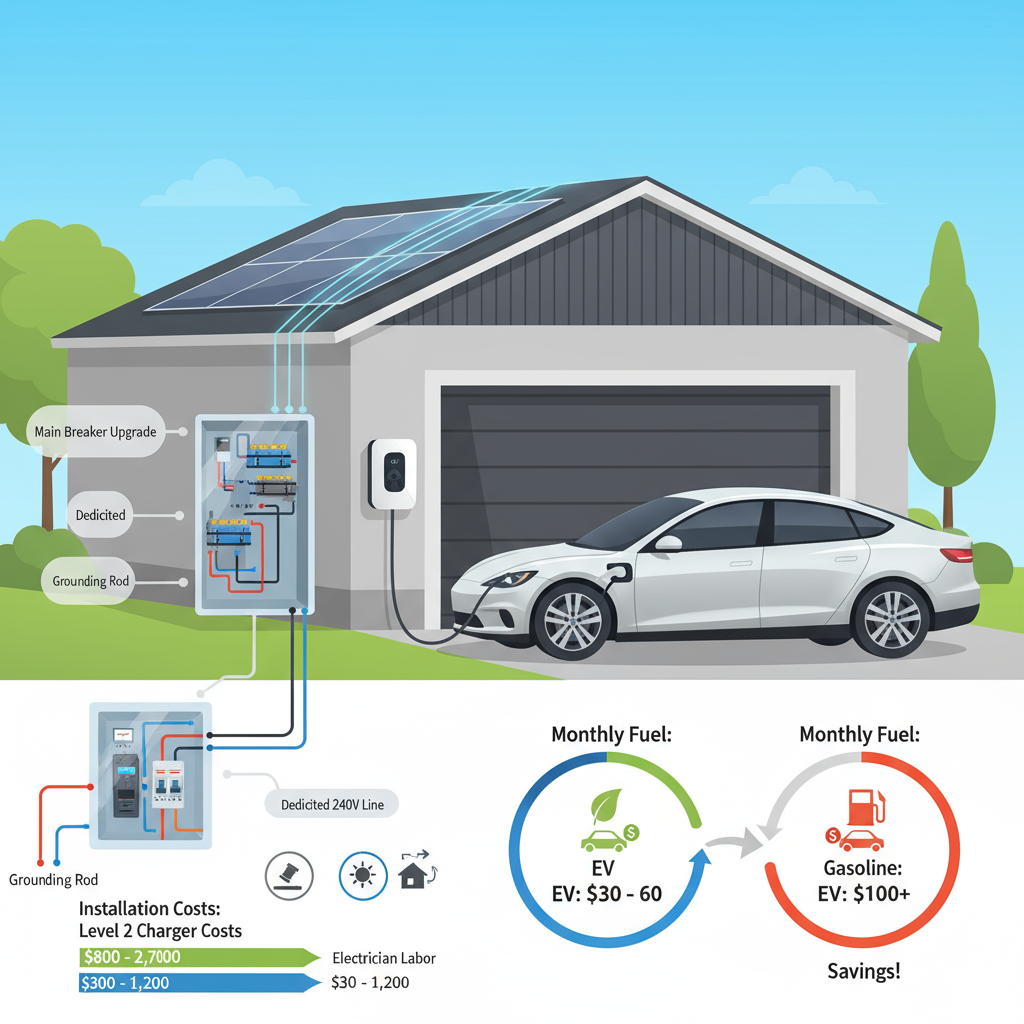
In 2025, installing a home Level 2 EV charger typically costs between $800 and $2,700, influenced by factors such as electrical panel upgrades, installation complexity, and permit fees.
Simple setups with existing 240V outlets may cost as little as $300 to $800, while more complex installations involving panel upgrades can exceed $2,500.
The chargers themselves usually range from $300 to $1,200.
Home charging is more economical than gasoline, with monthly electricity costs around $30 to $60 compared to over $100 for gas.
Service providers streamline installation and permitting, and incentives like rebates and tax credits help reduce upfront costs.
Additionally, integrating solar panels with EV chargers offers a sustainable way to lower long-term energy expenses.
Overall, despite upfront costs, home EV charging is becoming a cost-effective and environmentally friendly option.
Understanding 2025 Home EV Charger Installation Costs and Influencing Factors
As electric vehicles (EVs) become more prevalent, homeowners increasingly seek to install Level 2 charging stations to enable faster, more convenient charging at home. In 2025, the cost to install a home EV charging system typically ranges between $800 and $2,700. This variation reflects differences in electrical panel upgrades, installation complexity, existing infrastructure, and permit fees.
Installation Complexity and Electrical Setup Impact on Costs
The complexity of the charging installation plays a significant role in determining overall expenses. In some cases, minimal effort is required when a 240V outlet already exists—homeowners simply plug in the charger, resulting in low costs ranging from $300 to $800. However, most installations require installing a new 240V outlet close to the parking area. This involves electrical wiring, electrician labor, and securing necessary permits, bringing typical costs to between $1,200 and $2,000.
More complex situations arise when the existing electrical panel lacks sufficient capacity, necessitating panel upgrades or additional wiring runs over longer distances. These scenarios can require extensive work such as trenching or weatherproofing and may increase costs to over $2,500. Permit fees and electrician labor also contribute to the total installation cost.
In addition to installation expenses, Level 2 charger units themselves typically cost between $300 and $1,200. Thus, the combined cost of the charger and installation defines the investment required for home charging infrastructure.
Comparing Monthly Charging Electricity Costs to Gasoline
Home EV charging generally results in lower energy expenses compared to fueling gasoline vehicles. Monthly electricity costs for charging an EV often range from $30 to $60, depending on driving habits and electricity rates. For approximately 1,000 miles driven per month, home charging costs about $60, roughly half the equivalent cost of gasoline fueling, which can exceed $100. This difference highlights the economic advantage of electric vehicles, particularly when home charging infrastructure is in place.
Role of Service Providers in Streamlining Installation and Permitting
Service providers such as Qmerit offer bundled solutions that simplify the charging infrastructure installation process for homeowners. By combining site assessments, electrical panel evaluations, permitting, and installation labor, these providers reduce the complexity and administrative burden associated with home EV charger setup. Their expertise helps navigate local permit fees and electrical wiring requirements, ensuring compliance and timely completion of projects.
Utility Incentives, Tax Credits, and Solar Integration
Many utility companies and government programs offer incentives, rebates, and tax credits that significantly lower the upfront cost of installing EV chargers and related electrical panel upgrades. These incentives vary by region and can influence a homeowner’s decision-making process.
Integrating solar-powered EV charging systems has also become a practical way to optimize long-term costs. By coupling solar panels with EV chargers, homeowners can reduce reliance on grid electricity, lowering monthly charging electricity costs while enhancing sustainability. This approach is increasingly popular as part of a broader home electrification strategy.
Consumer Perceptions and Market Trends
Recent surveys indicate that while some consumers are concerned about the initial installation cost and potential complexities, many value the long-term savings and environmental benefits of home EV charging stations. Access to bundled installation services and financial incentives positively influences adoption rates.
Conclusion
The 2025 home EV charger installation market reflects a range of cost factors driven primarily by electrical setup complexity and regional permitting requirements. With level 2 chargers priced between $300 and $1,200 and total installation expenses spanning $800 to $2,700, homeowners can expect variable but manageable investments. Lower monthly charging electricity costs, streamlined service provider offerings, and available incentives all contribute to making home EV charging an increasingly viable and economical choice. Additionally, integrating solar-powered EV charging offers a sustainable avenue to further optimize costs and reduce environmental impact.

Frequently Asked Questions
Q: How much does home EV charging cost
A: The cost of home EV charging mainly depends on your local electricity rates and the capacity of your electric vehicle's battery. On average, charging an EV at home might cost between $0.10 to $0.30 per kWh, so a full charge for a typical EV with a 60 kWh battery can cost around $6 to $18. Additional costs may include the installation of a home charging station, which can range from $500 to $2,000 depending on the equipment and electrical work required. Overall, charging at home tends to be more affordable compared to public fast chargers.
Q: Best way to install EV charger at home
A: The best way to install an EV charger at home is to start by consulting a licensed electrician to evaluate your home's electrical system and ensure it can handle the charger’s power requirements. Choose a Level 2 charger for faster charging times, and decide on a convenient, safe location close to your parking area. Ensure the installation complies with local building codes and consider any available incentives or rebates. Finally, have the electrician complete the installation and test the system for safe and efficient operation.
Q: Qmerit EV charger installation service
A: Qmerit offers professional EV charger installation services designed to make the process seamless and efficient. They coordinate with customers to assess the site, obtain necessary permits, and schedule certified electricians for the installation. Their service ensures that your EV charger is installed safely and complies with local regulations, providing reliable and convenient charging at home or business locations.
Q: Federal and state incentives for home EV charging
A: In the United States, various federal and state incentives encourage the installation of home electric vehicle (EV) charging stations. Federally, the Inflation Reduction Act offers a tax credit covering up to 30% of the cost of purchasing and installing qualified home EV chargers, with a maximum credit of $1,000. Many states provide additional incentives, such as rebates, tax credits, or utility programs that reduce the upfront costs or offer discounted electricity rates for EV charging. These incentives vary significantly by state, so homeowners should check local programs to maximize savings on home EV charger installation.
Q: Level 2 EV charger installation price
A: The cost to install a Level 2 EV charger typically ranges from $500 to $1,500, including both the charger unit and labor. Factors influencing the price include the complexity of the electrical work, distance from the electrical panel, and any necessary upgrades to your home's electrical system. Some installations may be more expensive if a new circuit breaker or electrical panel upgrade is required. On average, most homeowners can expect to pay around $700 to $1,200 for a complete Level 2 charger installation.
Key Entities
Electrek: Electrek is a news website that focuses on electric vehicles, energy storage, and sustainable technology. It provides in-depth coverage of developments in electric mobility and clean energy sectors.
Qmerit: Qmerit is a company specializing in installation services for electric vehicle charging stations and energy solutions. It partners with utilities and businesses to facilitate EV infrastructure deployment.
Tracy Price: Tracy Price is a professional affiliated with Qmerit, involved in projects related to expanding electric vehicle charging infrastructure. Her work supports efforts to enhance EV adoption through improved installation services.
ComEd: ComEd is a major electric utility serving the Chicago area, responsible for power distribution and grid management. The company is actively engaged in promoting electric vehicle adoption through infrastructure initiatives.
United States: The United States is a country with growing investments in electric vehicle technology and infrastructure to reduce carbon emissions. Federal and local programs support the expansion of EV charging networks nationwide.
External articles
- How much does EV charger installation cost?
- how much did it cost you to install a level 2 charger at home?
- The real cost of installing a home EV charger | FLO
Articles in same category
- Tesla's Advertising Shift: Promoting Corporate Governance and Musk's Compensation
- Kia Boosts EV Production in Europe with New EV2 and EV4 Models
- Residential Clean Energy Credit Expiration 2025: Solar Adoption Impact
YouTube Video
Title: We Just Installed The ChargePoint Home Flex Level 2 Hardwired EV Charger! #evcharging #amazonfinds
URL: https://www.youtube.com/shorts/R6AuzYW9wio
Energy