

Three Major Solar Flares from Sunspot 4455 Raise Geomagnetic Storm and Aurora Risks
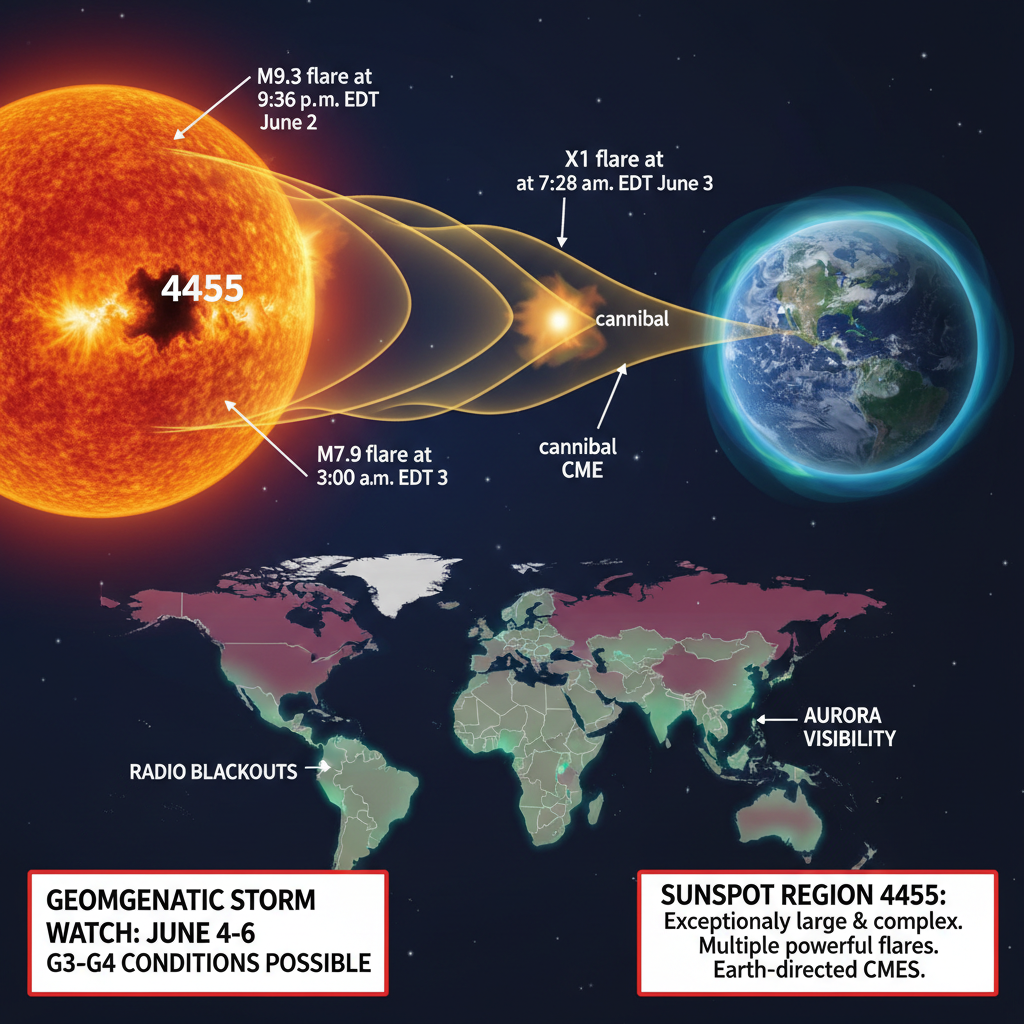
The sun released three major solar flares from region 4455 within 24 hours, launching multiple coronal mass ejections expected to reach Earth between June 4 and June 6.
These flares caused radio blackouts across East Asia, Australia, Europe, and Africa, and increased the chance of geomagnetic storms rated G1 to G3, possibly severe G4.
The storms may produce auroras visible as far south as mid-latitude U.S. states like Illinois and Oregon.
This unstable sunspot is likely to generate more solar activity in the coming days.

The Sun Has Released Three Major Solar Flares in 24 Hours, Increasing the Chance of Geomagnetic Storms and Aurora Displays This Week
The sun recently emitted three powerful solar flares in less than 24 hours from Earth-facing sunspot region 4455, generating multiple coronal mass ejections (CMEs) expected to impact Earth between June 4 and June 6. These eruptions have caused radio blackouts and elevated the risk of geomagnetic storms that could produce northern lights visible as far south as mid-latitude U.S. states.
Solar flares from region 4455 included an M9.3 flare on June 2 at 9:36 p.m. EDT, an M7.9 flare early on June 3 at 3:00 a.m. EDT, and an X1-class flare at 7:28 a.m. EDT June 3, the strongest in the series. These flares triggered R2 to R3 radio blackouts across East Asia, Australia, Europe, and Africa. The accompanying CMEs’ arrival is forecasted to cause geomagnetic storms rated G1 to G3, with possible isolated severe G4 conditions.
Key Points
- Three solar flares originated from sunspot region 4455: M9.3 at 9:36 p.m. EDT June 2, M7.9 at 3:00 a.m. EDT June 3, and an X1 flare at 7:28 a.m. EDT June 3.
- The flares caused R2 to R3 radio blackouts affecting parts of East Asia, Australia, Europe, and Africa.
- Multiple Earth-directed CMEs were launched, including a "cannibal" CME formed by one CME engulfing a slower predecessor.
- The U.K. Met Office issued a strong (G3) geomagnetic storm watch for June 4-6, with auroras possibly visible as far south as Illinois and Oregon.
- Region 4455 is an unstable "anti-Hale" sunspot, making it prone to continued solar flare activity in the coming days.
Solar Flare Activity and Effects
Sunspot region 4455, characterized by inverted magnetic polarity rare among less than 10% of sunspots, has become highly unstable and generated a series of powerful solar flares. The strongest flare, the X1-class eruption on June 3, represents the highest category of solar flare intensity, capable of impacting technologies on Earth. The space weather physicist Tamitha Skov highlighted the region’s growth in complexity and the elevated risk of continued X-class flares over the following 72 hours.
These flares released intense bursts of energy that disrupted radio communications, producing moderate to strong radio blackouts (R2 to R3). The blackouts mostly affected regions across East Asia, Australia, Europe, and Africa, signifying the global scale of the solar events’ impact on radio frequency use.
Coronal Mass Ejections and Geomagnetic Storm Forecast
Solar eruptions launched multiple CMEs—large clouds of magnetized solar plasma and radiation—that are traveling toward Earth. Models from NOAA show that one CME ejected by region 4455 caught and merged with a slower predecessor to form a "cannibal" CME. Expected to arrive mid-afternoon EDT on June 4, this combined CME is likely to trigger strong geomagnetic storms rated G3, with the potential for isolated severe G4 conditions.
The U.K. Met Office confirmed the presence of an Earth-directed CME associated with the M9.3 flare and is evaluating others linked with subsequent flares. Due to these eruptions, it issued a geomagnetic storm watch spanning June 4 to 6 signaling increased geomagnetic activity on Earth.
Geomagnetic storms disturb Earth’s magnetic field and can cause partial radio blackouts while intensifying aurora borealis displays. Normally confined near the magnetic poles, these northern lights may be visible much farther south during strong geomagnetic storms. NOAA predicts auroras could be seen in northern states such as Washington, Montana, North Dakota, Minnesota, and New York, with potential visibility as far south as Illinois, Oregon, and several other mid-latitude states.
Context and Implications
The solar flares from region 4455 are part of a broader pattern of activity linked to the sun’s 11-year solar maximum, reached in 2024. This peak increases sunspot numbers and solar instability, driving more frequent and intense solar flares and CMEs. The current period, sometimes called the "battle zone," exhibits increased magnetic field variability, producing unstable sunspots like 4455 and higher chances of geomagnetic disturbances.
Historically, major solar storms such as the 1859 Carrington Event—associated with an X45 magnitude flare—caused widespread technological disruptions and bright auroras seen near the equator. While the recent flares are less intense, they reflect the sun’s ongoing potential for significant space weather events, with continuing monitoring crucial to understanding impacts on satellites, power grids, and communications.
NASA, through its Solar Dynamics Observatory and other spacecraft, continuously observes the sun and space weather. The NOAA Space Weather Prediction Center remains the primary source for official forecasts, watches, warnings, and alerts regarding solar activity and its Earth-bound effects.
Conclusion
The sunspot region 4455 has unleashed a series of powerful solar flares and CMEs in early June 2024, significantly increasing the likelihood of geomagnetic storms through June 6. These storms may disrupt radio communications and power systems while producing spectacular aurora displays visible far beyond normal latitudes. Ongoing observations aim to track further flare activity from this highly unstable sunspot region as space weather impacts continue to unfold.
Questions and answers
Q: Latest solar flare activity June 2024
A: In June 2024, solar flare activity has shown an increase due to the approaching solar maximum in the current solar cycle. Several moderate to strong flares (M-class and some X-class) have been recorded, impacting space weather conditions. These flares can affect radio communications and satellite operations on Earth, especially in high-latitude regions.
Q: Impact of sunspot region 4455
A: Sunspot region 4455 has been notably active, generating multiple solar flares and potentially releasing coronal mass ejections (CMEs). Such activity can enhance geomagnetic disturbances on Earth, leading to increased chances of auroras and minor disruptions in satellite and communication systems. Monitoring this region helps predict upcoming space weather effects on Earth.
Q: When will geomagnetic storms hit Earth
A: Geomagnetic storms typically arrive one to three days after a solar flare or coronal mass ejection is ejected toward Earth. Current forecasts indicate that storms related to recent solar activity may reach Earth within 24 to 72 hours, depending on the speed of the solar wind and CMEs. Space weather prediction centers provide updates on expected storm timings based on solar observations.
Q: Aurora visibility forecast US 2024
A: Aurora visibility in the US during 2024 is expected to improve as solar activity intensifies toward the solar maximum. Northern states, especially Alaska and parts of the northern Midwest and Northeast, will have the best chances to see auroras. Occasional strong geomagnetic storms could push auroras farther south, making them visible in more central or even southern states during peak events.
Q: Effects of coronal mass ejections on Earth
A: Coronal mass ejections (CMEs) are large bursts of solar plasma that can impact Earth's magnetosphere, causing geomagnetic storms. These storms can disrupt satellite operations, GPS signals, and power grids while enhancing the visibility of auroras. Strong CMEs pose risks to astronauts and high-frequency radio communications, making monitoring them crucial for mitigating potential technological impacts.
Key Entities
Sunspot region 4455: Sunspot region 4455 is a particularly active area on the sun’s surface characterized by intense magnetic activity and solar flares. Monitoring this region helps scientists predict space weather events that can impact Earth’s communications and power systems.
U.K. Met Office: The U.K. Met Office is the United Kingdom’s national weather service, providing weather forecasts and climate science research. It also collaborates internationally on monitoring and predicting space weather impacts.
NOAA: The National Oceanic and Atmospheric Administration (NOAA) is a U.S. agency that monitors environmental phenomena including solar activity and space weather. Its Space Weather Prediction Center provides alerts about solar flares and geomagnetic storms affecting Earth.
NASA: NASA is the United States’ space agency responsible for space exploration and scientific research on solar phenomena. It studies sunspot activity and solar storms to better understand their effects on space and Earth environments.
Tamitha Skov: Tamitha Skov is a space weather scientist known for communicating solar storm forecasts to the public. She provides expert analysis on sunspot regions and their potential to disrupt technologies on Earth.
External articles
- R1 Conditions Return with Low-level M-class Flares
- Five historically huge solar events
- X1.0 solar flare erupts from geoeffective Region 4455
Articles in same category
- NASA Pushes Artemis II Lunar Mission Amid Government Shutdown and Leadership Controversy
- Orionid Meteor Shower 2025: Peak Viewing of Halley’s Comet Debris in October
- New Moon Oct 21, 2025: Orionid Meteor Shower Peak & Antares Occultation
YouTube Video
Title: Something strange is happening with the Sun...
URL: https://www.youtube.com/shorts/SNzQhpnjpI8
Science