

Register Today for California's Nov 4 Proposition 50 Election on Redistricting
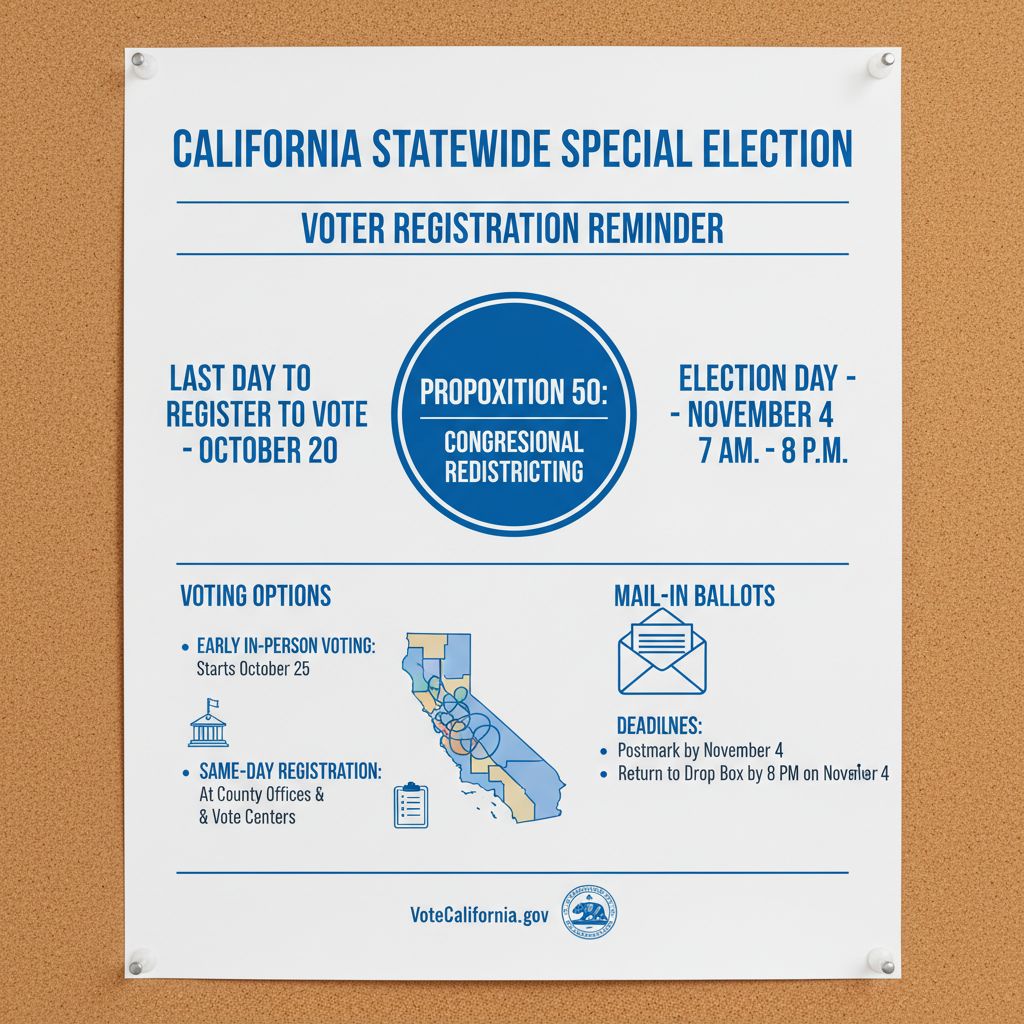
Today is the last day to register to vote in California’s special election on November 4, which centers on Proposition 50, a measure allowing the state legislature to temporarily redraw congressional districts through 2030. This initiative responds to recent partisan redistricting by Republican-led states like Texas that aim to gain electoral advantages in the 2026 midterms. Governor Gavin Newsom supports the measure as a defense of Democratic representation, while opponents warn it could politicize the redistricting process. Voters can register online by October 20 or take advantage of same-day registration at county offices and vote centers through Election Day. Early voting starts October 25, and mail-in ballots are being sent beginning October 6. This pivotal election carries significant implications for California’s congressional makeup and the national political balance.
Today is the last day to register to vote for the statewide special election on Nov. 4, when voters can consider Proposition 50, a Congressional redistricting measure
The statewide special election in California scheduled for November 4 focuses exclusively on Proposition 50, a measure concerning congressional redistricting designed to respond to partisan map changes in other states. Voters must register by October 20 to receive a mail-in ballot, though same-day registration will be available. This election carries significant political implications nationally, as it aims to counter efforts by Republican-led states to redraw congressional districts in their favor.
- The voter registration deadline for Proposition 50 is Monday, October 20, but conditional same-day registration is available at county offices and vote centers until Election Day.
- Early in-person voting begins on October 25 at designated vote centers, with election day voting on November 4 from 7 a.m. to 8 p.m.
- Proposition 50 would allow California to temporarily redraw its congressional districts through 2030 in response to partisan redistricting in Texas and other states.
- Voting by mail ballots are being mailed starting October 6 and must be postmarked by November 4 and received by November 12 to be counted.
- The election is highly contested, with Governor Gavin Newsom supporting the measure to defend Democratic representation, while opponents argue it politicizes the redistricting process.
---
Introduction
California’s upcoming statewide special election on November 4 centers solely on Proposition 50, a ballot measure proposed to redraw California’s congressional districts temporarily. This response is driven by recent redistricting legislation passed in Texas and other Republican-led states, aiming to create favorable conditions for their political party in the 2026 midterm elections. Governor Gavin Newsom has championed Proposition 50 as a crucial step to protect California voters’ interests against partisan gerrymandering elsewhere. Voters must act swiftly as today marks the last day to register to vote in this consequential election, with options for same-day registration to ensure broad participation.
What is Proposition 50?
Proposition 50, officially termed the Election Rigging Response Act, proposes that the California state legislature redraw the state’s congressional district maps temporarily instead of the Citizens Redistricting Commission. This commission, established by a 2008 state law to ensure nonpartisan boundary drawing following the decennial census, would resume its authority after 2030. The proposition is a direct reaction to the Texas Legislature’s August redistricting that favors Republicans by adding five new congressional districts ahead of the 2026 midterms. Missouri and several other GOP-led states are pursuing similar tactics. California’s Proposition 50 seeks to counterbalance those efforts, potentially creating five new majority-Democrat districts.
Matt Barreto, UCLA Voting Rights Project co-founder and political scientist, emphasized, “What the governor is doing is creating the political opportunity for the state legislature and, ultimately, the voters to approve a new set of maps in California.”
Political Context and Opinions
Governor Gavin Newsom and leading labor groups such as the California Federation of Labor Unions back Prop 50, framing it as necessary resistance against what they describe as attacks on working families by the Trump administration. Newsom stated, “Californians have been uniquely targeted by the Trump Administration... they will have a choice to fight back.”
Opposition comes notably from multimillionaire Charles Munger, Jr., who had supported the original redistricting structure. Munger opposes Proposition 50 on the grounds that it would repoliticize the redistricting process. He condemned Texas mid-decade gerrymandering but said, “the way to beat it is not to become like it,” arguing for maintaining the state’s independent commission approach.
This divide reflects broader tensions nationwide regarding redistricting and political control of the U.S. House of Representatives, where partisan mapmaking on both sides continues to shape electoral outcomes.
Voting Deadline and Registration Information
Registration Deadline
- The final day to register online to vote for the Proposition 50 election is Monday, October 20, 11:59 p.m.
- Voters can register online through the California Secretary of State or Alameda County Registrar of Voters websites.
- Those unsure of their registration status can check online at voterstatus.sos.ca.gov.
Same-Day Voter Registration
Individuals who miss the October 20 deadline still have the option to register and vote on the same day in person at county election offices or vote centers, including on Election Day, November 4. Provisional ballots are provided upon conditional registration and counted after approval.
Voting Options
- Early In-Person Voting: Vote centers open for early voting October 25, allowing voters to cast ballots, register, or drop off mail-in ballots.
- Election Day Voting: Polling locations are open November 4 from 7 a.m. to 8 p.m.
- Mail-In Ballots: Mailed beginning October 6 to registered voters. Must be postmarked on or before November 4 and received by November 12.
How to Vote by Mail
When voters receive their mail-in ballot, it includes a prepaid postage return envelope. Voters must carefully complete the single ballot sheet on Proposition 50, seal it in the return envelope, date, and sign it matching the signature on their voter registration or ID. Signatures are verified by election officials to validate the ballot.
Ballots may be returned by mailing, depositing in official county drop boxes, or dropping off at vote centers.
Election Stakes and Broader Impact
California’s decision in this election has repercussions beyond state lines. The measure attempts to neutralize partisan advantage gained by GOP-led redistricting efforts in Texas and elsewhere. California’s congressional delegation makeup and the national balance of power in the U.S. House hinge considerably on these decisions.
Political experts urge voters to consider multiple viewpoints and analyze the arguments thoroughly before voting. UCLA professors and civic organizations recommend attending forums and information sessions. UCLA’s Civic Learning and Democratic Engagement (CLDE) is hosting virtual and in-person events throughout October to educate voters about the pros and cons of Proposition 50 and its implications for democracy.
Additional Races and Measures on the Ballot
While Proposition 50 is the sole statewide measure, some Bay Area counties feature local races and questions, including:
- Fairfax, Marin County: Vote on recalling elected officials.
- Santa Clara County: Consider a sales tax and elect a new county assessor.
Resources and Engagement Opportunities
Voters can access comprehensive information on registration, ballot tracking, vote center locations, and election news via the California Secretary of State website and local election offices. Community groups and university organizations offer support for voter registration and education to encourage civic participation.
Conclusion
California’s special election on November 4, 2025, presents a pivotal moment for the state’s congressional landscape and the national political balance. Proposition 50’s approval would authorize temporary redistricting changes aimed at counteracting partisan gerrymandering practiced by other states. Voters have multiple ways to register and cast their ballots, including same-day registration and extensive early voting options. Engaged and informed participation is crucial, as the measure addresses both local representation and national electoral fairness.
With the registration deadline today, California voters must act promptly to ensure their voices are heard in this significant democratic exercise.

Questions and answers
Q: How to register to vote for Proposition 50
A: To register to vote in California and participate in voting on Proposition 50, you can complete the voter registration form online through the California Secretary of State's website, by mail, or in person at your county elections office. Registration typically requires providing a valid California address and proof of citizenship. Ensure you register before the state's voter registration deadline to be eligible to vote on Proposition 50.
Q: Proposition 50 election date
A: The election date for Proposition 50 depends on the specific election cycle in which it is placed. In California, proposition election dates are usually aligned with statewide primary or general elections. You can check the exact date for Proposition 50 on the California Secretary of State's official website or local county elections office announcements.
Q: California congressional redistricting measure
A: The California congressional redistricting measure refers to legislation or propositions intended to redraw the boundaries of congressional districts within California. These measures aim to ensure fair representation based on population changes reported in the latest census. Redistricting is managed by the California Citizens Redistricting Commission, an independent body that proposes new district maps for approval.
Q: Deadline for voter registration in California special election
A: The deadline to register to vote in a California special election is typically 15 days before the election date. However, California also offers conditional voter registration, which allows eligible voters to register and vote provisionally at their county elections office or designated vote center after this deadline up to and including Election Day. It's important to confirm the specific guidance for each special election on the California Secretary of State's website.
Q: What is Proposition 50 in California
A: Proposition 50 in California is a ballot measure that has appeared in various contexts over the years, so its content depends on the election in which it was introduced. For instance, one notable Proposition 50 involved water quality and supply improvements funded by state bonds. To understand the current or specific Proposition 50 details, it's best to consult official voter information guides for the relevant election year.
Key Entities
California: California is a U.S. state known for its large and diverse economy, including significant sectors like technology, agriculture, and entertainment. The state often leads in progressive legislation and policy developments, including environmental and infrastructure initiatives.
Proposition 50: Proposition 50 was a California ballot measure focused on funding water quality, supply reliability, and groundwater cleanup projects. It reflected the state's effort to address environmental challenges and improve water infrastructure for public benefit.
Gavin Newsom: Gavin Newsom is the Governor of California, known for his leadership on issues such as climate change, public health, and economic recovery. As governor, he has supported various state initiatives aimed at enhancing infrastructure and social services.
Texas Legislature: The Texas Legislature is a bicameral body responsible for creating state laws in Texas, composed of the House of Representatives and the Senate. It regularly debates policies related to education, energy, and state governance, often contrasting with California's legislative approaches.
Charles Munger, Jr.: Charles Munger, Jr. is an American investor and philanthropist, known for his work in finance and involvement in various charitable causes. He is the son of Charles Munger, the vice chairman of Berkshire Hathaway, and has played roles in business and environmental initiatives.
External articles
- Proposition 50 - California
- California redistricting battle draws $140 million in spending
- YES on Prop 50: FAQ
Articles in same category
- Senate Democrats Block GOP Stopgap Bill, Government Shutdown Enters 21st Day
- Paul Ingrassia Nomination Faces Backlash Over Racist Texts and Controversies
- Sanae Takaichi: Japan’s First Female PM and Conservative Shift
YouTube Video
Title: What to know if voting by mail in California's special election on Prop 50
URL: https://www.youtube.com/shorts/RtDf-kwLKL4
Politics