

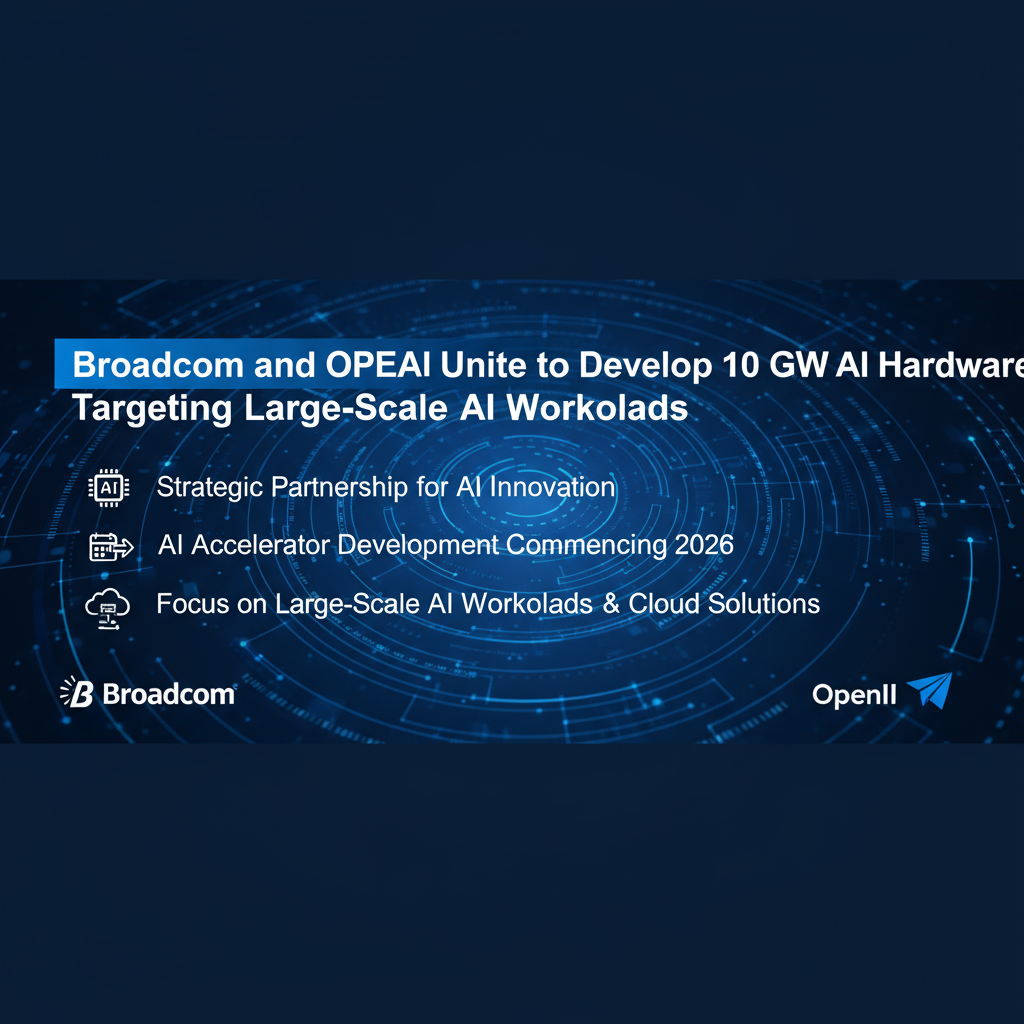
Broadcom and OpenAI Collaborate to Develop 10 GW AI Hardware for Large-Scale AI Workloads
Broadcom and OpenAI have formed a strategic partnership starting in 2026 to co-develop advanced AI accelerators, targeting 10 GW AI hardware aimed at large-scale AI workloads. This collaboration marks a significant expansion of Broadcom’s role in the AI semiconductor market, positioning it to challenge Nvidia’s dominance. Combining semiconductor innovation with integrated software solutions, Broadcom aims to deliver powerful, scalable AI hardware and software platforms tailored for hyperscale cloud providers and enterprise AI developers. The partnership underscores a commitment to sustainable growth and innovation in AI silicon and software, reflecting the evolving demands of next-generation AI infrastructure.
Broadcom and OpenAI Unite to Develop 10 GW AI Hardware Targeting Large-Scale AI Workloads
Broadcom and OpenAI have announced a strategic partnership to co-develop advanced AI accelerators, with development commencing in 2026. The collaboration centers on creating 10 GW AI hardware designed specifically for large-scale AI workloads. This initiative marks a significant expansion of Broadcom’s presence in the AI semiconductor sector and signals a direct challenge to Nvidia’s longstanding dominance in AI silicon markets.
Challenging Nvidia’s Leadership in AI Silicon
By leveraging its extensive expertise in high-performance chip design, Broadcom aims to carve out a competitive position against established industry leader Nvidia. The focus on building powerful AI accelerators reflects a broader ambition to supply AI hardware capable of meeting the demands of hyperscale cloud service providers, AI service providers, and enterprise AI developers who require robust performance and scalability.
A Diversified Approach Combining Semiconductor Innovation and Software
Broadcom’s business model uniquely combines semiconductor innovation with integrated software solutions, offering diversified revenue streams. This approach provides financial resilience amid the rapidly evolving requirements of AI hardware markets. Broadcom’s integrated AI acceleration hardware, paired with compatible software, aims to deliver seamless performance gains for hyperscale customers, setting it apart from competitors who may focus solely on silicon.
Targeting Hyperscale Customers with Integrated Solutions
The strategic partnership targets hyperscale customers, including large cloud service providers and AI developers managing extensive workloads. By offering combined hardware and software platforms, Broadcom positions itself as a comprehensive provider of AI acceleration technologies. This strengthens their capability to meet the complex and varied needs of enterprise clients seeking efficient and scalable AI computing infrastructures.
Commitment to Sustainable Long-Term Growth
This collaboration and Broadcom’s broader AI-focused strategy underline a commitment to sustainable growth in both AI silicon and software markets. By balancing investments in semiconductor design with software capabilities, Broadcom aims to maintain competitiveness and relevance in the future AI landscape. This balanced portfolio approach supports the company’s goal to become a pivotal player for AI acceleration across diverse industry segments.
Conclusion
The Broadcom and OpenAI partnership represents a notable development in the AI hardware ecosystem, promising substantial advancements in large-scale AI workload processing. By targeting 10 GW AI hardware and focusing on integrated solutions for hyperscale customers, Broadcom is set to challenge existing industry leaders while reinforcing its position through sustainable innovation across semiconductor and software domains. This initiative reflects the evolving nature of AI infrastructure, emphasizing collaboration and diversification to meet the demands of next-generation AI applications.

Frequently Asked Questions
Q: Broadcom OpenAI partnership details
A: Broadcom has partnered with OpenAI to enhance AI infrastructure and accelerate AI deployment across various industries. This collaboration focuses on integrating Broadcom's semiconductor technologies and networking solutions with OpenAI's cutting-edge artificial intelligence models. The partnership aims to improve performance, scalability, and accessibility of AI applications, helping enterprises leverage AI more efficiently. Together, they plan to optimize hardware and software ecosystems to support next-generation AI workloads.
Q: How Broadcom competes with Nvidia
A: Broadcom and Nvidia compete primarily in the semiconductor industry but focus on different areas. Nvidia is best known for its graphics processing units (GPUs) and AI accelerators, excelling in gaming, data centers, and artificial intelligence applications. Broadcom, on the other hand, specializes in networking chips, storage solutions, and telecommunications hardware, serving enterprise and infrastructure markets. While there is some overlap in data center technologies, Broadcom often competes by providing integrated connectivity solutions and ASICs that complement or compete with Nvidia's offerings in certain server environments. Both companies leverage innovation and strong customer relationships to maintain leadership in their respective niches.
Q: Broadcom stock performance analysis
A: Broadcom Inc. has demonstrated strong stock performance driven by its position as a leading semiconductor and infrastructure software solutions provider. Over recent years, the stock has benefited from robust demand in data centers, 5G technology, and enterprise software acquisitions, contributing to revenue growth and profitability. However, like many tech stocks, its price can be influenced by broader market trends, supply chain challenges, and geopolitical factors. Investors often consider Broadcom's consistent dividend payments and strong cash flow as indicators of its stable financial health.
Q: Broadcom AI chip development
A: Broadcom is actively involved in developing advanced AI chips designed to accelerate machine learning and artificial intelligence workloads. Their AI chips focus on delivering high performance, energy efficiency, and integration with existing data center and networking solutions. Broadcom leverages its expertise in semiconductor technology to produce chips optimized for AI inference and training applications, supporting diverse industries from cloud computing to telecommunications.
Q: Broadcom revenue model and business units
A: Broadcom operates a revenue model primarily based on the design, development, and sale of semiconductors and infrastructure software solutions. Its business units include Semiconductor Solutions, which covers products like networking chips, broadband access, and wireless communications; and Infrastructure Software, which provides enterprise software for data centers, mainframes, and cybersecurity. The company generates recurring revenue through product sales, licensing, and long-term contracts, serving diverse industries such as data centers, telecommunications, and enterprise IT.
Key Entities
Broadcom: Broadcom is a global technology company specializing in semiconductor and infrastructure software solutions. It plays a significant role in providing hardware components critical for AI computing and cloud data centers.
OpenAI: OpenAI is an artificial intelligence research organization known for developing advanced AI models like GPT. The company focuses on creating AI technologies aimed at ensuring safe and beneficial applications for society.
Nvidia: Nvidia is a leading manufacturer of graphics processing units (GPUs) widely used in AI, gaming, and data centers. Its hardware accelerates machine learning tasks and enables large-scale AI model training.
Google: Google is a technology giant known for its search engine and AI research through its parent company Alphabet. It develops AI tools and cloud services that support machine learning and data analysis worldwide.
Meta: Meta Platforms, formerly Facebook, is a major social media and technology company investing heavily in AI research and virtual reality. It integrates AI technologies to improve content recommendations and user engagement across its platforms.
ByteDance: ByteDance is a Chinese technology company best known for its short-video platform TikTok. It employs advanced AI algorithms to personalize content and enhance user experience globally.
Austin Hankwitz: Austin Hankwitz is a technology executive with experience in cloud computing and IT infrastructure. He has held leadership roles at companies such as VMware, contributing to advancements in virtualization and cloud technologies.
VMware: VMware is a software company specializing in virtualization and cloud infrastructure solutions. Its technologies enable businesses to optimize IT environments and support modern applications in virtualized settings.
External articles
- OpenAI and Broadcom announce strategic collaboration to ...
- OpenAI and Broadcom announce strategic collaboration to ...
- OpenAI and Broadcom partner on AI hardware
Articles in same category
- China's Gold Reserves: Transparency, Strategy, and Global Economic Impact
- Cryptocurrency Risks and Safe Haven Investments: From Crashes to Gold & Silver
- Silver Price Surge and Investment Opportunities with Sierra Madre Gold and Silver
YouTube Video
Title: AI Chip Deal: Broadcom's $100B Gamble & OpenAI #shorts
URL: https://www.youtube.com/shorts/exxLezN4TfY
Finance